The four in-store moments where retail media shapes customer decisions
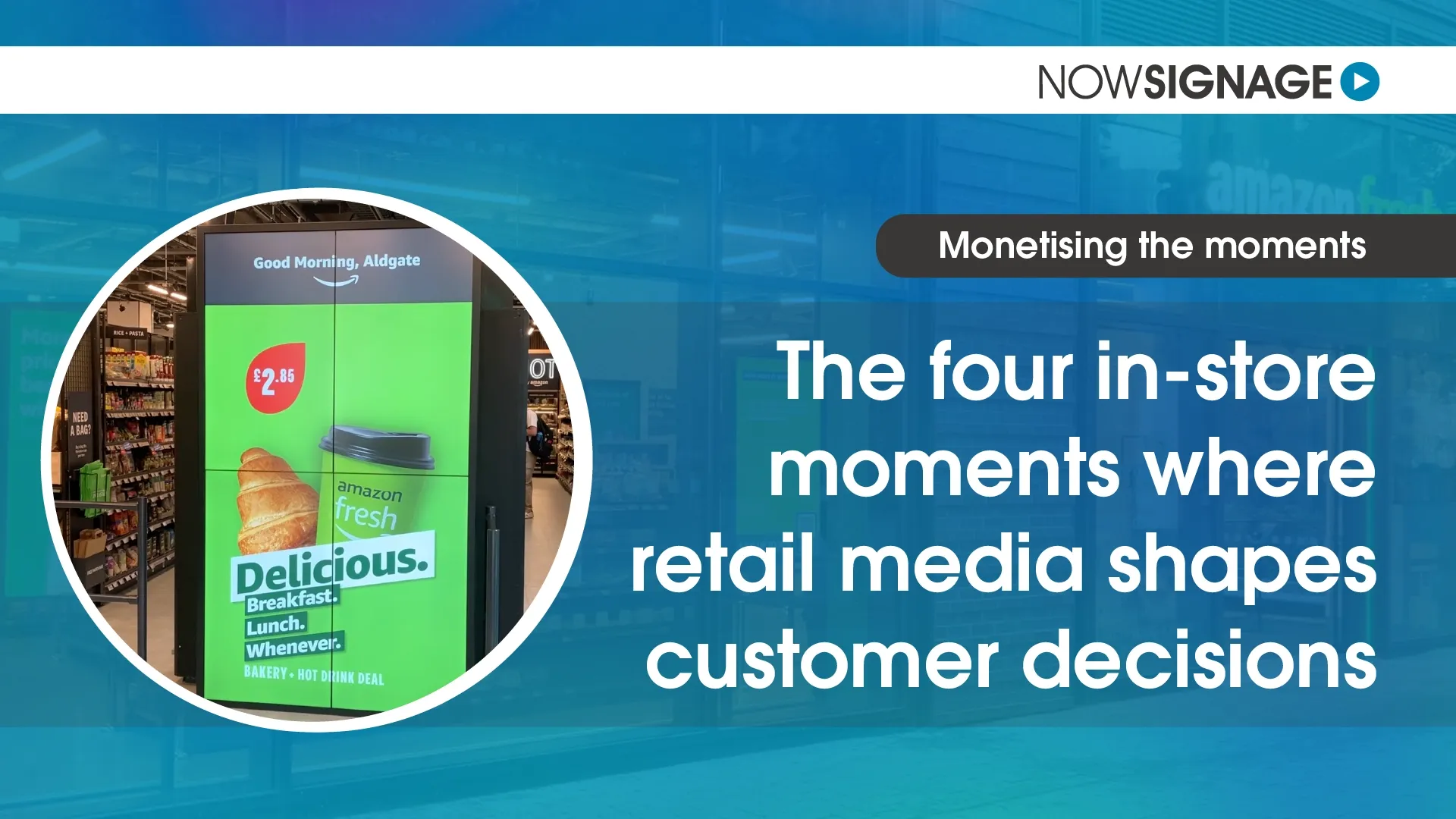


Retail media is often discussed as an ecommerce channel. Sponsored search, onsite placements and offsite activation get the budget because they are easy to measure, easy to buy, and easy to scale.
The issue is that many of the decisions that matter most still happen in store. Shoppers arrive with intent, but intent does not equal certainty. They still need to find, compare, validate, and commit. In-store retail media can influence those decisions in context, close to the point of purchase, while improving the store experience when it is designed around usefulness rather than noise.
That is the in-store opportunity. It is also where retail media can become operationally fragile. If the network cannot stay accurate, consistent and accountable across the estate, it becomes difficult to sell and hard to scale.
In-store retail media works when it acts like decision support
Treating in-store screens as “inventory” first usually leads to the wrong behaviour: too many messages, too little control, and a store environment that looks busy but does not help customers decide.
A stronger starting point is to map retail media to the moments where customers decide what happens next. When in-store media is planned, governed and measured, it can support conversion and basket performance. The same system then becomes sellable media inventory because brand partners get the control and accountability they need to invest with confidence.
That framing matters for retail media leads, but it matters just as much for operations and the C-suite. It turns a Retail Media Network (RMN) from an “ad project” into measurable in-store infrastructure, with clear ownership and performance expectations.
The four in-store moments where retail media can earn its keep
Most retail media programmes do not need “more screens”. They need a clearer role for the screens they already have (or plan to add), by zone and by store type.
Here are four moments that tend to carry the most practical upside.
1) Entrance and orientation: set direction quickly
The first few seconds inside the door determine whether a visit feels easy or not. Customers want value and direction quickly, without wading through clutter. In-store media supports this moment when it keeps priorities simple: wayfinding, service signposting, and a small number of offers that help customers choose where to go next.
From a retail media perspective, this is also where brand-funded messages can work well, provided they are tied to relevance and do not compete with basic navigation. If customers cannot find what they came for, no media plan will rescue the trip.
2) Aisle and range navigation: reduce decision effort where it spikes
Aisles are where comparison work ramps up. Customers are weighing options, checking value, and often cross-referencing their phones. In-store media adds value when it answers the questions that slow decisions: what is the difference, what is best for this use case, and what should I choose if I want the “safe” option.
For RMNs, this is where brands should want to show up, because attention is close to a decision. For retailers, it is where governance matters most. If promotional rules, eligibility, or price cues are unclear, hesitation goes up and trust goes down.
3) Feature zones: move from interest to confidence
In higher-consideration categories, feature zones exist to help customers feel confident enough to buy. In-store media can support this with practical guidance, differentiation, and demonstrations that reduce perceived risk and make the next step obvious.
This is also where retail media can look premium when it is executed well. The content feels like help, not interruption, and the environment supports both brand storytelling and conversion.
4) Queue and checkout: protect completion and monetise carefully
Checkout is a high-stakes moment. Customers want to finish, not think. In-store media works when it protects completion: expectation-setting, payment cues, returns reassurance, and a small number of relevant add-ons.
For retailers, queues and tills can be high-value attention real estate. But they need to be treated as a managed channel, with clear campaign controls and compliance reporting, rather than an ad dump that disrupts the checkout experience.
The operational truth: in-store retail media is a system, not a playlist
The difference between “having screens in stores” and having a credible in-store retail media proposition is not the screens. It is the operating model.
In-store retail media breaks down when it becomes cluttered, inconsistent, or hard to run day to day. Scaling it means putting governance, speed and reliability at the centre of the plan:
- Central governance to protect brand standards, category priorities and campaign rules.
- Local flexibility within guardrails so stores stay relevant by layout, language, range and trading conditions.
- Fast publishing to keep promotions, service updates and priorities current.
- Reliability across the estate, because blank screens damage trust and waste paid campaigns.
- Visibility and accountability so leaders can see what played, where, and correct issues quickly.
This is where operations teams should be involved early. If you cannot launch, pause, update and verify campaigns across the estate, in-store retail media becomes difficult to sell and harder to renew.
How NowSignage supports in-store retail media delivery
NowSignage helps retailers run in-store media consistently across multi-site estates, without adding operational complexity. It is simple to manage and update at scale, so teams can keep experiences relevant as conditions change across every store.
If you are building (or rebuilding) an in-store retail media proposition, the practical requirement is the same: control, consistency and accountability across the estate. That is what turns screens into a channel you can sell with confidence.
Get in touch to discuss your in-store retail media plans, or book a demo to see how NowSignage supports retail media delivery in practice.