How retailers can build a business case for digital signage - Step by step
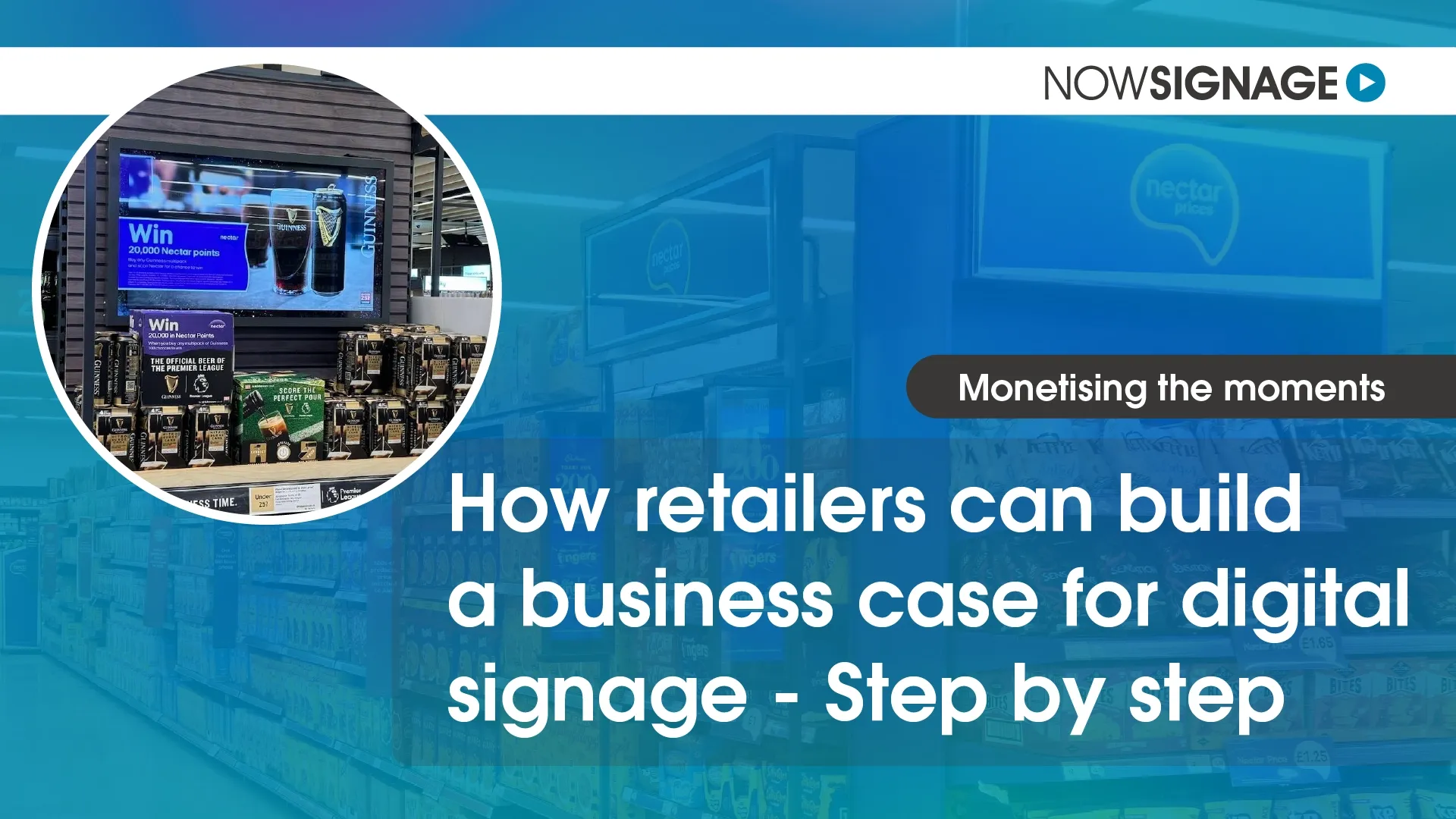


Digital signage is easy to justify when the conversation stays at the level of screens. Better looking stores. More “modern” comms. Faster updates than print.
It gets harder when a business case is required that holds up across finance, operations, IT and trading. The case is often framed as a marketing tool, when the value is far greater and more measurable: clearer in-store decision support, more consistent execution, and an operating model that keeps messages accurate day to day.
So start with a simple shift. A shift away from treating screens as a content project. Treat them as a store system. When digital signage is planned, governed and measured, it can improve conversion and basket performance, protect trust through price and promotion clarity, and reduce operational drag caused by inconsistent or outdated messaging.
Here’s a practical way to build the case, with the questions and inputs that tend to matter most…
Start with the commercial outcomes you already manage
A signage investment is easier to approve when it ties back to metrics the business already cares about, rather than introducing a new set of “engagement” measures that do not connect cleanly to store performance.
A strong business case typically anchors to outcomes:
- Higher conversion through clearer decision support (help customers choose faster, with fewer doubts).
- Improved basket performance via better attachment and bundles (use messaging to help customers complete a mission.
- Stronger trust through accurate pricing and promotion rules (reduce hesitation)
- Better service perception through clearer queue and checkout messaging (set expectations, guide self-checkout, and reduce perceived wait time).
This framing matters because it gives each stakeholder a reason to support the investment. Trading teams can connect signage to conversion logic. Operations and finance can see how the system reduces waste and protects revenue.
Define the role of signage in the customer journey (by zone)
Many retailers do not need “more screens” as a starting point. They need a clearer role for the screens they already have, based on where customers make decisions and where in-store friction tends to show up.
Build your business case around the moments where signage can do measurably positive work.
1) Entrance and orientation: get customers moving quickly
Inside the door, the store’s job is simple: help customers start the trip without confusion. Signage supports this moment when it keeps priorities tight: wayfinding, service signposting (returns, click-and-collect, assistance points, self-checkout), and a small number of offers that help customers decide where to go first.
Business case angle: faster orientation improves flow, reduces missed opportunities, and lowers the burden on colleagues who otherwise repeat the same “where is…?” guidance.
2) Aisle and range navigation: reduce decision effort where it spikes
The aisle is where customers compare products and decide what to buy. When faced with multiple options, many shoppers hesitate because they are unsure which product best meets their needs. Messages such as "Best for Families," "Most Popular," "Staff Pick," or "Top Rated" help shoppers quickly identify products that match their requirements without having to conduct additional research.
Business use case angle: clear signage can simplify the decision-making process by highlighting key differences between products, explaining promotions, and guiding customers toward suitable options.
3) Feature zones: turn interest into confidence
In higher-consideration categories, “feature zones” reduce perceived risk. These are zones where signage can provide demos, differentiation and practical guidance, then make the next step obvious.
Business case angle: better conversion where customers need reassurance, plus a more consistent “assisted selling” layer when staff availability varies.
4) Queue and checkout: protect completion
Checkout is a high-stakes moment because customers want to complete their purchase, not think. Signage works when it protects completion with expectation-setting, payment cues, returns reassurance, loyalty prompts and a small number of relevant add-ons.
Business case angle: lower perceived wait, incremental attachments, improved data capture (digital receipts, loyalty enrolment, app adoption) without disrupting the flow.
5) Returns and customer service: reduce cost-to-serve
Where returns create friction, signage can set expectations and explain what is required, what options exist, and what happens next. It can also support exchanges with clear, helpful alternatives.
Business case angle: lower cost-to-serve, reduced frustration for customers, and a better chance of retaining revenue through exchanges rather than refunds.
Make governance a first-class part of the investment
A signage programme fails operationally when it becomes cluttered, inconsistent, or hard to run day to day. This is a governance problem.
Your business case should describe the operating model that keeps signage useful:
- Central governance to protect brand standards, category priorities and campaign rules.
- Local flexibility within guardrails so stores stay relevant by layout, language, range and trading conditions.
- Fast publishing to keep promotions, service updates and priorities current.
- Reliability across screen networks, because blank screens damage trust and waste effort.
- Visibility and accountability so leaders can see what played, where, and correct issues quickly.
This is the point that often unlocks approval. It reframes signage as infrastructure the business can control, rather than “screens that might drift”.
Build measurement into the business case
Measurement is often treated as the final chapter in a signage project. In practice, it is how you protect performance and prove the system is being run properly.
Visibility matters because it makes exceptions manageable at scale. If a message is out of date or a screen is down, teams need to spot it quickly and fix it without relying on ad-hoc store feedback.
Turn “digital signage” into a costed operating model
A solid business case describes, clearly and simply, how your organisation will run the channel.
That means spelling out the work that will happen every week:
- Who owns content priorities and trading alignment?
- Who approves price and promotional rules?
- Who can publish, pause, and override content, and under what conditions?
- How will stores request local updates within guardrails?
- How will issues be identified and resolved at scale?
Answering these questions makes the investment feel operationally real. It also reduces the perceived risk that signage becomes another “project” that fades after launch.
Where NowSignage fits
NowSignage is a global digital signage platform designed to help retailers keep in-store messaging accurate, timely and consistent across large store estates. It supports practical operational requirements such as scheduling content by time of day, triggering updates using weather and sensor technology, keeping pricing accurate through ePoS integrations where available, and maintaining reliability with remote device management. All features are included as standard, with no hidden costs.
If you are building the business case, the practical requirement is the same across most retail environments: a platform that supports speed, consistency and accountability in day-to-day operations, without adding operational complexity.
Contact the team to book a demo and see what a customer-first, operationally sound signage approach looks like across a multi-site retail estate.
